Showing posts with label Yugioh. Show all posts

Monday, June 25, 2012

Card Review: Mind Control

Earlier today I've had the pleasure of testing my patience with what might have been the most annoying person I have ever dueled, via Dueling Network. I probably would have written a noteworthy story for the duel, but the only that would have been interesting, or mindlessly amusing rather, is how this inexperience child freaked out over how I operated the dueling simulator, given he had the impression that he knew how to actually play. Beside the point, in that duel that I was just waiting to end quickly, the card that helped me finish off my opponent was a Spell Card called Mind Control.

So lets examine this useful card. Mind Control is a Normal Spell Card that allows you to gain control of one monster that your opponent controls until the end of the turn. Like any card, Mind Control has its advantages as well as its disadvantages. Its disadvantages include being a Spell Card and the fact that the Monster you gain control of cannot be Tributed or declare an Attack. Inherently, not much is lost especially considering that Mind Control is a great card for any tactical Duelist. (I say that Mind Control being a Spell Card is a disadvantage because it can easily be negated, will only be used once, only has Spell Speed 1, and you'd have to undergo a totally different card in order to use Mind Control in your Deck. If there is one thing I have learned in my Economics class, it is that "The Opportunity Cost is the next best thing lost"). The advantages that Mind Control has are not directly listed on the card, contrary to the draw backs the card carries.

In the original season of Yu-gi-oh!, that so many people remember from a decade ago, there was a card that was capable of taking control of an opponent's monster called Change of Heart. That card has long since been added to the Forbidden List due to it's potency and lack of restrictions/drawbacks other than lasting only one turn. Brain Control was a slightly watered-down version of Change of Heart, but it only required a cost of 800 Life Points. Mind Control was made to sort of emulate the effect of Change of Heart or Brain Control, but its restrictions, such as the monster card affected being unable to declare an attack balance it out for fair play. Although Mind Control cannot match the power of Change of Heart, it does have certain advantage over another card that manipulates your opponent's monsters to shift over to your command, Creature Swap. Mind Control does not require you to have a Monster on your side of the Field in order to use, and best of all (my favorite part of the card is that,) Mind Control is not restricted to only targeting Face-Up Monsters, unlike Brain Control, the Battle Position does not matter when using this card! Creature Swap does not allow the Monster Cards affected to change their Battle Position, but since Battle Position does not really matter, you can Flip Summon a Monster card that you gained control of through the use of this spell.
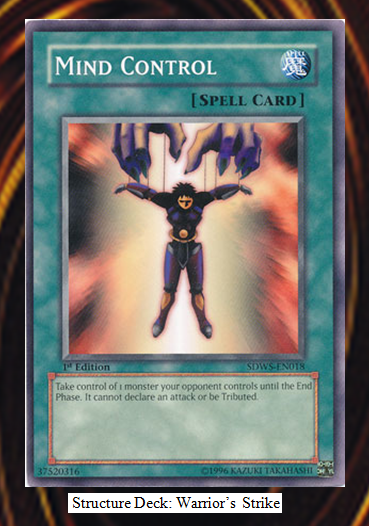


So what makes Mind Control so useful? For starters, sometimes all that stands in your way would be just one monster, one that might even have immunity to destruction by battle. Mind Control will allow you to move one of your obstacles out of your way in order to deal attacks. The Monster that you gain control of can even be used as Materials for a Fusion Summon, Ritual Summon, Synchro Summon, and even an Xyz Summon; so, although the monster cannot be tributed (for a tribute summon or for the cost of a card effect) it  can still be used as a resource to build your arsenal. In the case of my duel Earlier today, I gained control of my opponents only monster, which was in Face-Down Defense Position, I Flip Summoned and used it as Synchro Material, and then I had an extra monster to attack with to finish the Duel; with that one play, I got rid of a monster and gained another in return.

Because of its potency, Mind Control is currently on the Limited List, which means only 1 Copy is allowed per Deck in the Advanced Format for tournament use. Mind Control is available in Gold Series 2 Booster Packs and is included along with the Warrior's Strike Structure Deck. I would consider this card a "Staple".


Tuesday, June 19, 2012

Envoy of the Beggining

It's Summer, and that means that many people will have extra time on their hands to select a new past time to partake in. However, most that choose dueling as their new favorite activity will find themselves quickly overwhelmed. Without guidance, these people will have a difficult time learning how to duel and allow their skills to grow as their knowledge of the game expands. Sure, knowing the rules of the game is crucial, but it takes more than just knowing how each turn moves along to become a great duelist. A skilled duelist requires lots of experience, which is also important for any upcoming duelists that desire the ability to compete against others. Today I provide my advice to anyone seeking to learn more about this popular game or to anyone seeking to teach others how to get started as a duelist. Half of entire game is dependent on your deck building, so I will focus on that first.

What most new duelists have in common is that they are unsure about what kind of deck to use. It hardly makes a difference whether the newcomers to the game are people that used to collect cards a few years ago or people whom have never owned a single Yugioh trading card in their life. So much has changed in dueling since Yugi and his friends were the only stars on the show that fought with Duel Monsters, and so many new cards have been introduced that it is easy for anyone to become overwhelmed with the sheer number of possible selections. Nevertheless, the most important thing to remember is: Have fun, and enjoy the game with your friends. I cannot stress this enough, but the most important thing to remember is that dueling is all about having fun and enjoying the leisure time you share with your companions. So, with that in mind, lets help a new duelist build a their own deck.

[It is possible to Play Yugioh without needing to buy a single card, thanks to Dueling Network. However, for the sake of simplicity, let's also assume that the theoretical duelist in question has a decent amount of money to buy a few sets of cards and accessories.]

To get started, a player should seek what type of deck they would like to use. They can browse on the internet for popular cards or watch other players. (I highly recommend watching other people play first to see if it is something you would enjoy.) But, if a newcomer should start buying cards, the best place to start off with a deck: either a Starter Deck or a Structure Deck. Starter Decks contain a wide range cards but only provide a general taste of what dueling is really like; they are very basic and are meant for beginners. Structure Decks are more "structured", focusing on a group of Monster Cards with similar Types, Attributes, or play styles; Structure Decks are effective teaching tools for new comers because they can immediately show players how one card relates to another which can lead to powerful combos. 

[This was pretty much the "Choose Your Starter" of the 5D's Era; except, these weren't 
Starter Decks. These are Structure Decks]


Alright, so once you've decided on what kind of deck you'd like to make (Be it, Spellcasters, Warriors, Machines, Fairies, or a deck of a certain Archetype) the next important part is researching the cards! That's right, great duelists actually take their time to study the cards that they will use and beyond! My advice to anyone who wants to play or just understand how the cards work is: "Read your cards at least four times before you use them." Sometimes the amount of ignorance some duelists display confounds me, but as G.I. Joe says, "Knowing is half the battle", and this is most certainly true (especially in dueling). Besides, reading a small trading card is nothing compared to reading long novels assigned as by school teachers. Understanding exactly what the card says is crucial to running your deck, and as long as you are able to explain to others precisely how it works, you are fine; but there is more! After learning how the cards work from the Starter/Structure Deck you bought function (For those of you who will use Dueling Network, instead of buying the Decks you can easily search online for the complete deck list) Look up other cards that might work well with your Deck. If some cards work better than others that you already use, you can always replace them. (Remember what the SIDE DECK is for! It is a pile of 15 cards that you can swap with your Main Deck in between duels, during a match.)

Now that a duelist has chosen their preferred deck type, they must also understand the premise or the goal that their deck should achieve and how it should be achieved. A player's deck may consist of one type or attribute, but the play style and mechanics of the deck may differ from an other player with a similar deck. Although there are other ways to win a duel besides reducing the opponent's Life Points down to zero, the most common method is indeed reduction of life points, mostly through battle. With that said, decks may achieve their goal by summoning Powerful monsters quickly, summoning many monsters to withstand a barrage of attacks, utilizing powerful attacks, holding high reserves in resources by having plenty of "draw power", negating attacks, effects, or cards and summons altogether, destroying opponents cards, etc.. You'll have to ask yourself what you want your deck to be capable of doing. Would you want powerful monsters to over power your enemies with physical force? (Beatdown: having high ATK) Or, would you like to use explosive cards that deconstruct the battle plans of your opponents? (Utilizing card effects that Destroy other Cards.)  There are so many possibilities, but that is what overwhelms new players early on. The best thing to do is to narrow down the focus of your deck. A novice mistake that lots of people make is packing their deck with as many cards as possible: 60. The smaller the deck, a minimum of 40 Cards, increases the chances of drawing much needed cards. So, focus on what you want out of your deck, and build upon that premise. If you play more constructively, you will use cards that support your Monsters, but make sure they are efficient. If you play more destructively, you will use cards that ruin your opponent's deck, but makes sure that your own monster will still be able to support and protect you if something goes wrong.

After you've got a built deck, the next important step is to use it! But before you rush into any duel, it is crucial that you completely understand how the game works. A rule book and an interactive demo can only teach you so much, although it is a great start, but I highly recommend dueling against a friend whom already understands dueling quite well. Should such a friend not be available, you can always learn more about dueling online, through forums, or through my favorite source, The Yu-Gi-Oh! Wikia. There, you can read the official rulings for cards, read more about the mechanics of a duel with greater detail, and find out more about the different decks, booster packs, and archetypes that are available. Extensive studying and practice rounds earn you the experience you need to become a great duelist. The better guidance you have, the better your first impressions and experiences of dueling will be.

But always remember the most important part about dueling: Having fun. If the game isn't fun then it won't be engaging and it will just make everything worse. Having good friends to play with and teach you will certainly make things better, and if dueling is fun, you will find yourself "studying" cards without realizing that you are actually researching something. Remember the simple steps: Pick a deck you'd like to make/use, work on it, test it out with a friend who can teach you more rules on dueling, and always review your cards, your deck, and keep an eye out for other possible cards to add to your deck.

For the official rulebook, click here: http://www.yugioh-card.com/en/rulebook/
For an tutorial on the rules, click here: http://www.yugioh-card.com/en/gameplay/demo.html

Wednesday, May 2, 2012

Card Review: Gorz, The Emissary of Darkness

Time for another card review, but this time, of one of my personal favorite cards. Seriously, this card has been there for me in so many duels. I can almost associate it as my "duel spirit" or something of such significance since it appears in almost all of my duels. In almost every opening hand, he has volunteered to lead the assault. In fierce duels when I have expended my hand and my other monsters have fallen to other creatures slightly stronger than they, I have drawn him to aid me; and even just when my opponent believes that they can begin to overrun my life points with sheer force when I seem defenseless, he is there for me and comes to the rescue. He is, Gorz, the Emissary of Darkness.

So, let's examine this Dark Legend. Gorz, the Emissary of Darkness is a, DARK Attributed, Level 7 Fiend/Effect Type monster, fighting entire armies with 2700ATK and 2500DEF. Immediately Gorz shows to be impressively powerful Monster Card, and he even looks impressive in the artwork as well! But what really makes Gorz so grand is how he is invoked onto the field. Although you can Tribute 2 Monsters to Normal Summon him like any other card, his effect allows you to Special Summon him from your hand, but only under reckless conditions; this, however, is what makes him so interesting to use, in addition to his 1 of  2 Effects that activate as a result of his unique Special Summon.


While you control absolutely no cards on the field and you take Direct Damage, you can Special Summon Gorz from your hand. There are 2 Effects, and 2 Types of Damage; so each Effect is associated with the type of Damage taken after Gorz is successfully summoned. If you suffer Effect damage, you Gorz will also inflict the same amount of hurt right back to your opponent. If you suffer Battle Damage to Summon Gorz, which is commonly the case, he will not be alone; for the Emissary of Darkness will bring along his most trusted companion: Kaien.


 [There she is... Isn't she beautiful?]

After deducting your Life Points due to Battle Damage, Gorz Special Summons 1 "Emissary of Darkness Tokem". This Monster was named "Kaien, the Emissary of Darkness" in the Yu-Gi-Oh! R manga and an official "Emissary of Darkness" Token Card was printed exclusively for Japan. I will refer to this card as Kaien.

Kaien is a LIGHT Attributed, Level 7, Fairy-Type TOKEN Monster Card with ?/? ATK/DEF. Her ATK/DEF are both determined by the amount of Battle Damage Taken after Gorz hit the field. Because of this, there is strategy into timing the utilization of Gorz, the Emissary of Darkness. Often times waiting for the heavier attack yields a greater reward in the form of a stronger TOKEN Monster, but this tactic increases the risk factor. Kaien being a TOKEN Monster just means that she will be treated as a Normal Monster while on the Field, but she can still be Tributed, Declare Attacks, defend, and even be used as Fusion, Ritual, and Synchro Material. With that said, Kaien can be just as useful, or even more effective, than her Male, Effect-Monster counterpart. Kaien tagging along with the fight only provides more flexibility in your options.

These Scenarios. 
1) IN THE BEGINNING OF THE DUEL:Your first hand, is nothing but Monster Cards: A few too weak to survive the first turn and the rest are too strong to use at the moment, except for Gorz! End your first turn without having a single card on the field. Take a hit from your Opponent on their turn and you instantly have at least 1 Monster with 2700 ATK! 
2) IN THE MIDDLE OF THE DUEL: Or this one: You have no Spells or Traps. Your Opponent activates a Card Effect to wipe out any Monsters you would have had on the field. He attacks. Gorz springs into action from your hand! Usually, his high stats may intimidate the opponent from continuing their barrage of attacks. 
3) NEAR THE END OF THE DUEL: Or, how about both of you are engaged in a fierce duel and you are both down to your dwindling decks. A tiny monster is just poking at you for the time being. When you draw Gorz, the Emissary of Darkness (if it was still in your Deck by this point in the Duel), the story completely changes! The possibilities are endless! (Not really...)

So, Gorz can instantly summon himself and another Powerful Monster, he can be easily summoned by other means such as Tribute Summon or by effects of other Cards, and he is practically a two for 1 card under highly risky conditions.  Remember, you must not control ANY cards ON THE FIELD if you plan to instantly Summon it. This is the most important detail to remember when using this card. In many duels, Gorz alone can change the tide of battle. Because of his immense potency, he is on the Limited list which means that only 1 copy of the card is allowed per Deck. (How about that for a "Highlander" card?)

Many times I have used this card because many times he has been there for me. Even when I asked to borrow a deck from a friend at a party, I drew Gorz on my opening hand. Gorz can be fitted into almost any deck, as long has he doesn't compromise the functions of the deck. (Example: If using even 1 DARK monster would kill your deck, don't use Gorz.)

Gorz, the Emissary of Darkness was originally printed as a Promotional Card for the Yu-Gi-Oh! R manga, but is most commonly available in the Dark Legends Booster Blister Set, which includes 2 booster packs of 12 Cards each, as well as Gorz, the Emissary of Darkness itself. Trivia Fact: The Gorz cards included with the Dark Legends packs are all misprinted; since they are promo cards but have a silver seal instead of a golden seal on the lower left corner.

Saturday, April 7, 2012

Card Review: Ceasefire

Since I'm on the "Simple Cards are too complicated to understand to many duelists" mood, here is another one of my personal favorites that just makes so many people mad! I present to you Ceasfire! One of the most powerful cards that I have ever had in using. With only three sentences to explain its effects, this card somehow manages to throw so many duelists into confusion, skepticism, and even fits of rage that lead to them quitting.

So lets examine the terms of this card. Ceasefire is a Trap Card that inflicts 500 Points of Damage to your Opponent for every Effect Monster on the Field, including your own and your Opponent's. The only requirement to activate this card is that there is at least 1 Monster on the field. First, Ceasefire flips face up all Face-down monsters on the field, if any. If there happens to be only Face-Up Effect Monsters this card can still be Activated. In addition to flipping Face-up any Face-Down Monster Cards, Ceasefire prevents the Activation of Flip Effect Monsters, cards whose Effects only Activate at the moment that they are Flipped by Battle, Effect, or Position Change. Once all Monsters are Face-up, all Effect Monsters are counted and that Value is multiplied by 500 and then inflicted as Damage to your Opponent.

Simple enough, right? Well, many there are many misconceptions about this card whenever people do not read it correctly. People will think that there needs to be Face-down Monster Cards in order to activate this card. The real effect of this Card is the Last/Third Sentence of the Card; the First two sentences are added to increase the Card's Potency. Ceasefire wants to check ALL MONSTERS on the Field to see if they are Effect Monsters, the card's main variable. It would be much more simple to Flip all Monsters on the field (if any are even Face-down) and to look and check and then return them Face-down.


This card is so powerful that it is currently on the Limited List, and it doesn't seem like it will be freed from from that list any time soon. Since Effect Monsters are so common high amounts of Damage can be Inflicted. and with 10 Monster Card Zones in total on the Field, Ceasefire has the Potential to deal up to 5000 Points in Effect Damage. Ceasefire is recommended for Decks that can Summon many Effect Monsters quickly and is a great Side Deck Card to use against  Decks that Summon many Effect Monsters. Ceasefire can also remove the dangers of cards like Morphing Jar, Ryko The Lightsworn Hunter, Man-Eater Bug, Needle Worm, and so forth since each of those Monsters are Flip Effect Monsters. Even if the Face-down cards were not Flip Effect Monsters, Ceasefire can also help you avoid taking Damage from Attacking strong defensive Monsters like Destiny Hero - Defender by revealing what cards they really are before rushing into battle. (Remember, all it needs to do is check ALL MONSTERS.) Ceasefire can be found in Structure Deck: Machina Mayhem as a Common Rarity card.

Card Review: Gachi Gachi Gantestu

Time for another card review! But first off, I just have to say, this card is awesome. Hands down. Few cards come close to being as useful as this guy is. However, I seem to have a major problem with this card concerning just how everyone else sees it. The only reason I feel like talking about this card right now is because I just finished a duel with and narrow minded player that refused to accept the terms of this card. I present to you one of the Xyz Cards that was introduced along with last year's Starter Deck, Starter Deck 2011: Dawn of the Xyz, Gachi Gachi Gantetsu!

So let's examine this support hulk. Gachi Gachi Gantetsu is an, EARTH Attributed, RANK 2 Rock/Xyz/Effect-Type Monster with only 500ATK points and 1800DEF points. He requires 2 Level 2 Monster Cards to be summoned. It might seem weak, but everyone seems to LOVE this card greatly. Honestly, almost everywhere I've been where duelists gather to duel and trade cards it seems like people beg to trade for this card! Why is it so good? Simple: its effect, its defensive capabilities, and accessibility.

Since Gachi's DEF is higher than his ATK, the primary strategy utilized when summoning him is to play him in Defense mode. At 1800 DEF, most monsters will have difficulty trying to knock down this guardian. However, Gachi really shines because of his simple Effect(s). Gachi's abilities are summarized with only two sentences, yet the duelist that just walked out on me after ignoring what I had to say managed to get confused with this card.

First Effect: If Gachi Gachi Gantetsu was to be destroyed, you can instead Detach 1 Xyz Material from him instead. This effect includes both heavy Battles and dangerous Card Effects. So, it is implied that you'd have try Destroying this guy three times for him to finally hit the Graveyard, and remember, those 1800DEF points are already high for many of the lower level Monsters. Second Effect: ALL Face-up Monsters that the controller currently controls gain 200 ATK/DEF for for each Xyz Material Attached to Gachi. Since Gachi requires 2 Monsters to be Summoned, he will have 2 Materials attached to him, and all monsters you won will initially gain a 400ATK/DEF Points Bonus. (2x200=400). The power boost may seem minuscule on paper, but sometimes those slight advantages can make all the difference. This is what really makes Gachi Gachi Gantetsu really useful for almost any Deck, especially the ones that utilize more Level 2 Monsters. Gachi does not exclude any Monster on your team to share his strength with, not even his own self. So, a fresh Gachi would actually have 900ATK and 2200DEF (assuming he has all of his Material) which makes him even more of a challenge to overcome.

Requiring only 2 Level 2 Monsters makes Gachi relatively easy to Xyz Summon. Without a specification on what types of Level 2 Monsters are required leaves it wide open for almost any Monsters. One of the more useful cards that I reviewed earlier that fits this role perfectly is Quillbolt Hedgehog, which can revive itself from the Graveyard as long as you control a Face-up Tuner Monster. Because of this, you can even build a Deck that can allow you to summon "Black or White" Cards from your Extra Deck. (Also, if you happen to use "Over-Tune" with Quillbolt Hedgehog by Overlaying it after you Used Quillbolt's effect, he will not be Removed From Play after being Detached.) 


My opponent walked out on me because he refused to understand how the Effects of this simple 2 Sentence Monster Card worked. The ATK/DEF boost works for all FACE-UP MONSTERS on your side of the field, of course, if you Control Gachi. Since Gachi does not discriminate on Monster Card Type, Attribute, Level, Etc. Etc., that Effect will work on ALL Monsters, even himself. (He is a Monster, that is Face-Up, and under YOUR Control, right? Approved for Stimulus Package.) Had the card been written that "OTHER Face-Up Monsters..." then he'd be left without his heightened Defense. The second part that confused my opponent was the whole "Detach for Effects" principal. Traditionally, Most Xyz Monsters can only activate their Effects by Detaching a certain amount of Xyz Materials as the Cost. (This statement sounds so strange since Xyz Monsters are still very new in my mind.) Gachi Gachi Gantetsu does not need to Detach any Materials to grant his allies extra power. Had this been the case, the effect would have been useless since the text specifically measures the added strength based upon how many Materials Gachi has attached. Sadly, my opponent refused to see this. The only occasion that Gachi would ever Detach Materials from himself is when he is facing Destruction, and this is to save himself, and only himself; and since this Effect can only be triggered to that occasion, this Effect can be used even on your Opponent's Turn since it is not restricted to your own turn. (Note: that effect only prevents Destruction. Returning to hand/deck does not count as Destruction, but as "Leaving the field" Same is true for Removing from play/Banishment.) I feel that I have stressed the mechanics of this card long enough. It's a simple Card, yet, in Yugioh many complicated explanations are required to justify the workings of a card. Fellow Duelists, if you are ever facing disputes concerning this card, show your opponent this analysis. I hope that I have been able to clarify the game better.

So, to Summarize, Gachi Gachi Gantetsu is a great card because it is easy to Summon, difficult to Destroy, and boosts the strengths of your giving you a slight advantage over your opponent. Many times that extra little 400ATK boost hands the game over to controller of this bulky Xyz. The only problem, as I mentioned earlier, is that everyone seems to want this card. Gachi Gachi Gantetsu is only available in Starter Deck 2011: Dawn of the Xyz as one of the 3 Xyz Cards included with the Deck. Many Duelists are not really incited to go out and spend $10 on a deck for just one card, yet they can go out and hassle Duelists for it.

Tuesday, April 3, 2012

Card Review... Overview... SPELL CHRONICLE!

Okay, so I recently started looking through my collection of cards again and while sorting through my main inventory of cards I stumbled upon, once again, a card that I just cannot seem to figure having a purpose... I'm serious! This card, initially, is terrible; but, it seems that every time I go back to reread its effect it perpetually worsens and changes into a more detrimental card... This card is Spell Chronicle.

So let's examine this infamous card. (Infamous in my eyes.) By examine, I literally mean, examine the text of the card word per word just to see how reckless it can be to use. Talking about this card really isn't high on my priorities, but it's been on my mind since I looked at it again and I just feel like getting it out of the way.

 Spell Card /
Send all cards in your hand to the Graveyard. Select and remove from play 5 Spell or Trap Cards from your Deck. Each time your opponent activates a Spell Card, place 1 Chronicle Counter on this card. You can remove 2 Chronicle Counters from this card to have your opponent select 1 of the cards removed from play with this card's effect, and add it to your hand. When this card is removed from the field, you take 500 damage for each card that is still removed from play due to this card's effect.

So, off the bat, this Spell Card has a pretty lengthy description [to most players] judging by how squished together the text is printed on the card. Let's start off with the COST to use the card.

First sentence: "Send all cards in your hand to the Graveyard." That is quite a hefty cost, to require sending every card you have in your hand to the grave. Alright, there may be some cards that can utilize Discarding (from hand) to form combos, but the truth is that there is a difference between Sending a card and Discarding a card to the Graveyard. Granted, the Cost can be reduced by using as many cards in your hand as you possibly can before activating this. (Imagine using all cards in your hand except for 2: This spell and 1 extra card.) Of course, complications rise by having certain cards that cannot be used due to the circumstances that would come in handy later on. (A powerful Monster Card)

Next is what this card actually does. Spell Chronicle, after activating it, forces you to remove 5 Spell/Trap Cards from your deck. These cards are set aside in a 'Graveyard/Discard Pile beyond the Graveyard/Discard Pile' to be added to your hand through its effect. "Select and remove from play 5 Spell or Trap Cards from your Deck." How does Spell Chronicle Work? Some cards function by collecting Counters on themselves. Often, these counters can only be obtained by specific events in the duel: Summoning of Monsters, Activation of Card Effects, Etc. etc. (Many Spellcaster Type Monsters function by using Spell Counters, the most common type of card Counters that exist in the game.) Because Spell Chronicle uses special Counters called "Chronicle Counters", the only can collect the counters to use this card is by its own effect. "Each time your opponent activates a Spell Card, place 1 Chronicle Counter on this card."

Collecting Chronicle Counters is only possible when your Opponent Activates a Spell Card as long as Spell Chronicle is Face-up on the Field. One Spell Card Activation performed by your Opponent adds only 1 Chronicle Counter to your card. So, you've removed your 5 Spell/Trap Cards from your deck and you are waiting for your Card to rack up enough points to collect your cards set aside. But wait a minute, in order to add just 1 Card that was set aside from your hand, you must remove 2 Chronicle Counters from Spell Chronicle! [Math time: 1 Chronicle Counter = 2 Spell Card Activations from Opponent. 2 Counters needed for 1 Spell/Trap to add. You removed 5 Spells/Traps from your deck. In total, you'd have to collect 10 Chronicle Counters in order to completely take advantage of this card's effect. Leaving room for your opponent to activate 10 Spell Cards is much too risky. A complete Turn around can happen by then.] "You can remove 2 Chronicle Counters from this card to have your opponent select 1 of the cards removed from play with this card's effect, and add it to your hand." As if having to wait even longer to regain your own cards wasn't bad enough, you do not even get to choose which card to redeem.

So after all of that trouble to attempt manipulating your deck to your advantage in mid-duel, there is more! An extra drawback effect. "When this card is removed from the field, you take 500 damage for each card that is still removed from play due to this card's effect." So after going through all of the trouble of paying a high cost to try removing Cards from your Deck in hopes of being able to use them more effectively, potentially losing them for the rest of the duel if the plan fails, you may also suffer up to 2500 Points in Damage! Considering that this card is a Spell Card, or simply the fact that it is a Card in the world of Yugioh, Spell Chronicle is already in danger of being destroyed by cards like Mystical Space Typhoon. It does not matter how many Chronicle Counters this card had when it was destroyed: you are looking at 500 Points in damage for each Card you fail to redeem. (Your Opponent can be a jerk and not use any Spell Cards at all. You might as well take a direct hit.)

Surely this card must have a purpose, or is able to be used in SOME kind of deck. To be honest, there is one kind of deck that might be able to use it. Before I considered looking for tips on how to effectively use this card, I tried figuring out on my own a practical use for it. I couldn't figure it out. Apparently Spell Chronicle can be used in Macro Decks, Decks that focus on Removing from play Cards. Certain Macro Decks can use Monster Cards that are powered by the number of cards that have been removed from play. One recommendation is to use another card call Soul Absorption to cancel out Spell Chronicle's damaging effect by gaining Life Points by 500 for each card Removed.

Despite the small amount of card tips I've found on how to use Spell Chronicle, I still say that it is a pretty terrible card. It's very complicated to actually use and to completely understand just what this card does and how it works requires plenty of textual analysis. I haven't even seen Macro Decks, the one kind of deck that was recommended for using Spell Chronicle, did not need to use this card and would only provide just another variation of the build. Spell Chronicle is a scary card because it is so dangerous and highly impractical to use. It only has 5 sentences, but those 5 sentences compose one of the most complicated cards ever created.

Monday, March 26, 2012

Card Review + Card Combo: Arcana Force 0 - The Fool / Arcana 0 Swap

Here is a quick post to get some posting momentum started again. Here is a rather interesting card I'd like to talk about. The reason I'm deciding to do a card review AND a card combo in the same post is because both would be very short for posts on their own. .I obtained a long while back. Arcana Force Cards are and Archetype of Fairy Cards with two different effects for each of them, a good one and a bad one (to the player using them). The effect is

THE CARD
So let's examine this strange card. Arcana Force 0 - The Fool is a, LIGHT Attributed, Level 1 Fairy-Type Effect Monster with 0 ATK and 0 DEF. Since this card is so weak, what makes it so great? The answer is in its Effect(s). Initially, Arcana Force 0 is immune to battle, no matter what battle position it is in. But here's the catch, once The Fool is in Face-up Attack Position it cannot switch itself into Defense Position.

But, wouldn't that make itself more dangerous? Precisely, but this is where the Card Combo kicks in to make great use of this odd card; but first, you must know of 0's other effect(s).

Arcana Force is an archetype of cards that are based off of luck: Whenever a monster is SUMMONED (this detail is important for the combo) their effects force you to flip a coin. The result of the coin flip determine which Card effect the monster will use. With one being positive (Coin lands on Heads), and the other being negative (Coin lands on Tails), Arcana Force 0 - The Fool almost breaks the rules by inverting its own mechanic.


THE COMBO
To utilize the Arcana 0 Swap, you must SET (Play it into Face-down Defense Position) Arcana Force 0. You must wait for your opponent to attack your set monster. If they try attacking it, you will not need to worry unless your opponent's monster has special abilities such as Piercing Damage or Monster Card destroying Effects. This next part is when things become most confusing. When your Set Arcana Force 0 is attacked, it will FLIP into Face-up Defense position, but it technically WAS NOT SUMMONED; therefore, a coin flip will not be needed. (Remember, The Fool has a really nasty negative effect. By Setting this Monster Card and waiting for your Opponent to attack it you are removing the gamble of being burdened with a dangerous hole in your defenses.) Another thing to remember is how the card's Effect is written. The card clearly says that "This card cannot be changed to Defense Position." If you notice the keyword here, Arcana Force 0 was never CHANGED INTO Defense Position, so there will be no complication with the rulings right now.


Now that you have your Face-up Arcana Force 0 set up, you just need a card called Creature Swap. Creature Swap is a Spell Card that forces you and your Opponent to choose one of your own Monsters and switch control of them. In addition to switching Monsters, the swapped Monster Cards cannot change their battle positions for the remainder of the turn; so make sure to activate this card only when your Opponent Controls only Attack Position Monsters. Before Activating Creature Swap, change your Arcana Force - 0 into Face-up Attack Position. Switch 0 over to your Opponent.


The goal of this card is to create a hole into your Opponent's Defenses. When you trade the Arcana Monster over to your Opponent, you now have a significantly weak target to aim at. In addition, the card cannot be destroyed by battle, so all of your Monsters can attack it on the same turn. The only draw backs are that this combo may take some time to use, and can easily be stopped if your Opponent is stocked on Spell and Trap Cards. The other side effect of this combo is that you give your opponent another Monster Card that they can sacrifice for a more effective cause without compromise.

Both of these cards are available as Common Rarity cards and are easy to obtain. (Arcana Force 0 - The Fool is only found in The Light of Destruction Booster Pack, but Creature Swap can be obtained from many Decks.) In my experience, it is a fun combo to use and as long as it works it can interest even the one you are dueling.

Monday, February 13, 2012

Card Review: Summoner Monk

Here is a card that is useful for many decks, but is often hard to come by. With an incredibly useful effect, this card opens up the possibilities for many combinations to bring forth bigger, stronger, and more powerful monsters!

So let's examine this master evocator of monsters. Summoner Monk is a, DARK Attributed, Level 4 Spellcaster/Effect Monster with 800 ATK and 1600 DEF. Clearly not made to battle, especially because he immediately switches to the defensive upon summoning. (Unless Flip Summoned.) 800 ATK is very low for a Level 4 Monster, so it is probably a good thing that he switches to defense mode anyways. What makes this card so special is that he can Special Summon any other Level 4 Monster from your deck, at the expense of 1 Spell Card from your hand; the monster MUST be Level 4. The Monster Special Summoned by this effect cannot attack the turn the effect is used, and the effect is limited to being allowed only once. Those drawbacks are minor trade offs for being able to Summon Rank 4 Xyz Monsters like Number 39: Utopia, or Synchro Summoning Monsters if the aforementioned  Special Summoned card was a Tuner.

Summoner Monk fits best in decks that use many Level 4 Monsters and expendable Spell Cards. Because it is a DARK monster, Summoner Monk may be used to fit the costs of lots of Card Effects that affect DARK Monster, like Allure of Darkness, which calls to remove 1 DARK Monster from your hand.


Summoner Monk is another example of a highly potent card as it was once restricted to only 1 card per deck on the Limited List, but is now Semi-Limited which means that 2 copies are allowed per deck. The reason that Summoner Monk's cost is a Spell Card is that the deck he is included in is a Spell oriented Deck. A great card but often difficult to come across. They are very reliable when added to certain decks, and so they are valuable.

Sunday, February 12, 2012

Card Review: Number 39: Utopia

Recently I made an overview of the 4 Ace Cards held by the main protagonists of each Yu-Gi-Oh! show. Number 39: Utopia is used by Yuma Tsukumo and is also the cover card for Starter Deck: 2011: Dawn of the Xyz. Even now, Number: 39 Utopia is probably the only reason that people are buying the new Starter Deck, save for a few new and good cards that are included with the deck itself. Personally I really like Number 39: Utopia because of it's artwork and significance in the new Yu-Gi-Oh! show. He looks like a noble warrior that is ready to defend anyone.

So let's examine this defender from the other side of the universe! Number 39: Utopia is a, LIGHT Attributed, RANK* 4 Monster/Xyz/Effect monster with 2500ATK and 2000DEF, just like the other iconic 'Legendaries'. 'Utopia' is a very defensive Card; even with 2500ATK points, there are many cards that can still defeat it in battle. To cope with this, his effect allows him to Negate Attacks, by using its "Xyz Material" (dubbed in the show as "Overlay Units"), the monsters used to Summon for the Summoning of Utopia. Under normal conditions, he will be able to Negate 2 attacks; it doesn't matter who is the one attacking. In most cases, Utopia will not have to Negate ALL attacks since this effect is optional, and for anything to actually pose a real threat, your opponent's monster would have to be 2500ATK Points strong or stronger or possess a deadly effect like that of Ally of Justice Catastor to make you expend an Xyz Material. Utopia can protect the user from 2 attacks, but I would like to say that he can actually block a total of 3 attacks!


The theoretical third attack that Utopia can black is derived from his draw back effect. The unfortunate drawback is that if he is attacked (attacked=/=attacks) by an opponent's monster whilst having no Xyz Material to shield himself with, he will be destroyed. Basically, without his powers, Utopia can die with his own effect; although, upon will self destruct, the monster that attacked him will not be able to attack again for the turn, unless another effect will permit it to do so. So imagine 3 Blue-Eyes White Dragons on your opponent's side of the field; all you have is a fresh Number 39: Utopia on your side. Blue-Eyes 1 and 2 attack, you Negate both attacks by detaching 1 Xyz Material for each attack. (Since the effect does not say "Once per turn", it is implied that you may use it multiple times on the same turn.) Now that Utopia is unguarded, the last Dragon attacks, but Utopia takes one for the team. The battle is nullified and you won't have to suffer from battle damage since the last Blue-Eyes will not be able to attack again.

Being only Rank 4, this card is relatively easy to summon because most of the useful cards utilized in many decks tend to be Level 4. Overall, it is a good card that is both useful and fun to use.

This card recently received an evolved form that is more aggressive, in the new booster pack. In other trivia, Number 39: Utopia looks like the Lancelot Knightmare mech from the Anime Code Geass.

*RANK is a status that Xyz monsters operate by. Instead of using Levels that are lined from the right side above the card art, Ranks are lined from the left side above the card art. Rank is represented by golden stars in black orbs, as opposed to yellow stars in red orbs for Level. Rank and Level are NOT the same, and any Xyz Monster technically has no Level (but still may not be used as a Synchro Material Monster, until a card that specifically says so is made).

Monday, January 30, 2012

Card Review: Road Warrior

Alright, it is time for another card review! The card I will review today happens to be a cover card, but not just any cover card. This card was the first Synchro Monster I obtained when I returned to dueling, and aside from another special card that I've held in my possession for so many years, this card was also the most powerful card that I had when I started on my "Duelist Genesis". Simply because it is a cover card does not inherently mean that it is one of the best, but it is also not one of the worst. Personally, I find Road Warrior to be an interesting card, however, it is apparent that he is not so recognized as other Synchro Monsters out there.

So let's examine this golden Synchron Warrior. Road Warrior is a, LIGHT Attributed, Level 8 Warrior/Synchro/Effect Monster, fighting with 3000 ATK Points and 1500 DEF Points. (In a normal battle, this card could match the Blue-Eyes White Dragon.) First off, the main thing about Road Warrior that I should address is that it is what I would like to call a "Synchron Synchro", or in this case more specifically, a "Synchron Warrior". Synchron Warriors are Monsters that require a specific Tuner Monster to be summoned. These Tuner Monsters have "Synchron" in their name, implying that they Synchronize with other Monsters to become an even more powerful Monster; the Synchrons are used by Yusei Fudo in the anime. Although the Synchrons are not part of an actual archetype, their similarities do pair them up for some interesting trivia.

Now, about Road Warrior. Road Warrior might not be considered to many as one of the greatest Synchro Monsters available. At the time of its release, Road Warrior might have even been the most difficult Synchro Monster to summon. It requires Road Synchron (Level 4) and at least 2 Monsters to add up to a Level 8 Synchro Summon. In terms of the game, that either means waiting 3 turns to Normal Summon 3 weak monsters or exploiting resources in a single turn to Special Summon the necessary monsters to summon Road Warrior. Road Warrior's Effect is very simple. Because of his Effect, however, Road Warrior is simply not made for just any kind of deck. Road Warrior was made to lead decks that use weaker Warrior-Type or Machine-Type Monster Cards. Unfortunately, many people do not see his Effect as being very useful when they could use the Monster he can Special Summon as potential for further Summoning. Despite boasting 3000 ATK Points, Road Warrior probably would not be the optimal choice for many duelists and would be picked after another Synchron Warrior. (I don't often see many of these being used. I am probably the only person I know that has Summoned this guy.)


Since Road Warrior requires Road Synchron as its Tuner, I might as well make a short review of that card as well. Road Synchron is a, LIGHT Attributed, Level 4 Machine/Tuner-Type Monster with 1600 ATK and 800 DEF. For a Level 4 Monster, 1600 ATK is an adequate amount of strength, but still closer towards the lower end of the stronger monsters. Road Synchron's Effect raises its Level by 1 if it battles until the end phase; this effect is so that it might open more possibilities for Road Warrior's Summoning. Road Synchron is not limited to only being used to Synchro Summon for Road Warrior. Since it is a Tuner without restricting itself to being used only for a specific Monster, Road Warrior can be used for other monsters however, it is essentially treated as a Level 2 Tuner for the Synchro Summon of any Monster other than Road Warrior.

Road Warrior strikes me as a card that looks really impressive. Although Road Warrior probably would not be summoned for many duels, it is still one of the cards I find having fun with. I have Synchro Summoned this card before and used it to my advantage, however I may need to utilize more Level 2 or Lower Warrior-Type or Machine-Type as part of my deck. The little Monster that he was able to summon did provide useful for further Summoning or defenses.


"...And now I Synchro Summon ____________!"

This is a misprinted Road Warrior that I received in a Duelist Pack: Yusei Fudo 2 Booster Pack. Everything about it is fine, except it lacks its name. It would have been a Rare** Road Warrior, but because it lacks the foiling from its name and is not "shiny" at all, I call it the "Common* Road Warrior". Road Warrior is only available in Rare and Ultra Rare*** Rarities.

*Common Rarity is identified by having no foiled qualities about the card. Simply because a card happens to be of Common Rarity does not mean that it is not very valuable.
**Rare Rarity is identified by having only the name foiled and nothing else.
***Ultra Rare Rarity is identified by having golden foiling of the card's name and a holographic picture.

Friday, January 27, 2012

Card Review: Summoned Skull

I mentioned before that there are other cards as strong as Dark Magician that require less effort to use. One of Yugi's other iconic monsters is a great example of such a card. Summoned Skull.

So let's examine this other creature of darkness lead by Yugi's command. Summoned Skull is a, DARK Attributed, Level 6 Fiend-Type Normal monster with 2500ATK and 1200DEF. Because this Monster is Level 6, it only requires just one Tribute to Normal Summon it. Because it has 2500ATK it can match the strength of Dark Magician. Summoned Skull is an interesting card, mostly for Trivia. Apparently its original design, which is what the Anniversary Edition Artwork attempted to capture, is obviously much different than the design that most people have seen. Summoned Skull is supposedly related to another set of cards, or an archetype of cards known as Archfiends.


Summoned Skull can be used in various forms of Normal Monster Card-based decks, which rely on Monster Cards that have high ATK.

Monday, January 23, 2012

Yu-Gi-Oh! Generation V

Okay, so today I will take a break from talking about the old Yu-gi-oh! cards. (And I actually do mean "old". So far all of the cards I have talked about are relatively old; but it's all good.)

Almost a year ago the newest Pokemon games, Pokemon Black Version and Pokemon White Version, the Fifth Generation, were released in North America. For a whole decade I was reluctant to actually buy or even play a Pokemon game, but that is another story. It wasn't until Gold Version and Silver Version were remade into Heart Gold and Soul Silver Version for the Nintendo DS that I began to consider trying to play a Pokemon game after the many years I first tried it, especially with the new Pokewalker device that made the game seem even more enticing. But it was not until I began to look into Pokemon Black and White that I really got serious about beginning to play these games. After I realized that at one point I did like Pokemon and began to develop an interest in the new games especially for its enhanced graphical capabilities, and I am not actually what some gamers might call a "graphics whore", I began to ask myself 'what version should I even buy?'


At this point I was not researching too heavily on what Pokemon were exclusive to which version and like most people I tried to base my decision off of judging the book by its cover, or in this case, judging the game version off of its cover monster. I spent a while looking at the two monsters and I tried listening to opinions regarding both cover Legendaries. One even described Reshiram (the white dragon) as a creature designed by Dr. Suess. As weighed the choice I was presented with in my mind to predict how my decision might affect my appeal to aesthetics, I began to joke around about the design of the two dragons. Finally, as I payed closer attention to the obvious contrasts in the proposed game's color scheme I noticed something funny.


"One is a white Dragon-Type Monster with blue eyes and the other is a black Dragon-Type Monster with red eyes!" It was a joke that I told to my friend, who is an avid Pokemon Trainer. This was just a funny little parallel that I drew between Yu-Gi-Oh! and Pokemon. Eventually I came across this very same joke on the internet, with an image that paired Reshiram (white dragon) with Zekrom (black dragon) in a double battle against Blue-Eyes White Dragon and Red-Eyes Black Dragon.

Sunday, January 22, 2012

Card Review: Compulsory Evacuation Device

Here is another simple yet effective card. (well, on the surface it is simple, yet for some reason certain duelists tend to over complicate this piece of text. More on that later.) Compulsory Evacuation Device is 1 card with 1 effect. It is very useful and often it isn't very hard to come across one in a trade folder or in a duel.

So let's examine this trap card. As it's text would suggest it returns 1 Monster on the field to it's owner's hand. This means that you can choose either your own or your Opponent's Monster to "bounce" back into their hand, since the card does not specify. But why is this so good? Wouldn't you rather want to destroy your Opponent's Monster instead? Well, in most cases that you would use this card, Destroying one of your Opponent's monsters may not be one of your available options. Even in some cases it may benefit you more to "return your opponent's monster back into their hand". Certain Monsters may require more effort and resources to summon than to revive. Imagine that your opponent Tributes 2 of their Monsters to Summon Blue-Eyes White Dragon or uses certain Spell Cards or Card Effects to summon the beast. If you DESTROY (and send to the Graveyard) that Blue-Eyes your Opponent can easily use Monster Reborn to revive it; however, if you use Compulsory Evacuation Device on that dragon, the monster is back in their hand, which means that they will have to expend more of their resources just to summon that Blue-Eyes White Dragon... AGAIN! This card is highly effective against Fusion, Ritual, Synchro, and Xyz monsters, since those kinds of monsters require either a Spell Card and/or certain Monsters to Special Summon them. [Monsters that Originate from the Extra Deck like Fusions, Synchros, and Xyz's will return to the Extra Deck instead of the Hand.] Compulsory Evacuation Device can even be used to "waste" your Opponent's Normal Summon or Set for the turn. (just like that Blue-Eyes White Dragon Example.) So, your Opponent Normal Summons a Level 4 Monster that can defeat your Monster in Battle. If you'd like to keep your monster safe, you can "bounce" back that freshly summoned monster back into their hand, and they will not be able to Normal Summon until the next turn. (Unless they activate Double Summon, which permits 1 Extra Normal Summon or Set for the turn.)


Now, how does this card become over complicated? Well, it mostly happens when a Monster activates its Effect upon its Summon. (Monster Summoned, Effect should activate, but this card is activated.) I am still looking into this ruling, but I have encountered duelists with different opinions on this cards ruling. Some debate that this card can even nullify (Not Negate, but Nullify... as in, the effect just simply disappears and is unable to resolve) a Monster's Effect.

Overall, this is a simple but awesome card. You can be a real jerk using this card, as it is easy to throw off an opponent with this card. Be aware though, you may never know when this card is set, just waiting to throw you away. Like the previous card, this card is also considered a "Staple", although many decks are not built to include this card.